The growing pace of the technological era that we live in today has led to rapid advancements in the field of education.
The traditional method of teaching in a classroom environment is not the only effective way to learn and gain new skills. It is here that the concept of a learning management system becomes relevant.
With this blog, we aim to provide information on what is LMS system, along with the benefits of the online learning management system.
So, let’s not stop here and get deep into this blog post.
Introduction to Learning Management Systems
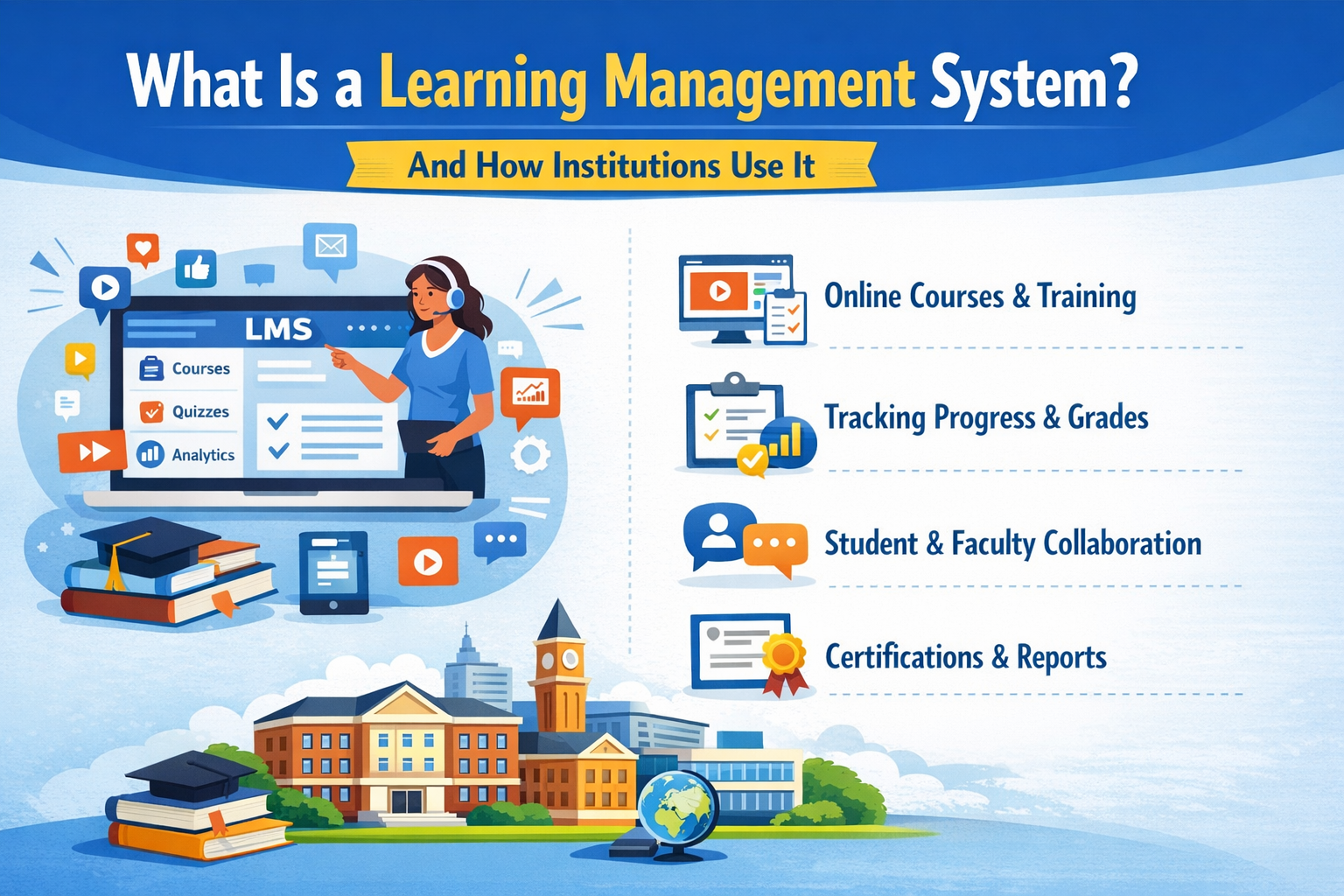
Learning Management System, commonly shortened to LMS, is an e-learning software solution for planning, delivering, managing, and evaluating educational and training initiatives.
Essentially, an LMS is an e-learning central point of organization and communication where institutions and tutors are able to host course resources and learner activity and facilitate communication between the learners and tutors.
LMS helps facilitate the process of learning and delivering learning digitally by making it easy for institutions and companies to deliver a standardized and measurable learning experience.
This can be either for college-goers or working individuals at companies, as it fosters a structured learning experience.
What Is an LMS System?
When we inquire about what is an LMS system, we are talking about the whole technological system that accomplishes the following educational tasks:
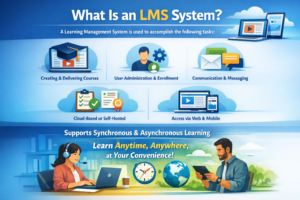
- Creating and delivering courses
- User administration and enrollment
- Correspondence and communication
- Assessment and certification
- Communication and collaboration tools
An LMS solution may be offered as cloud software and as self-hosted software and may be accessed via web browsers and/or mobile devices.
Since LMS systems are intended to facilitate both synchronous and asynchronous learning, learning processes are no longer dependent on time and location because students are able to adapt their learning schedule according to their convenience.
What Is Learning Management Software?
The term learning management software; describes the software program that carries out the concept of LMS. This software makes it possible for the administration and training staff at educational centers to:
- Posting and organizing the class materials
- Create Quizzes & Assessments
- Assign learning paths to users
- Monitor progress and engagement
- Award certificates on completion
This software is much more than a content-sharing tool; it has capabilities such as analysis, reporting, and automation that optimize the entire learning cycle from onboarding to advanced training solutions.
What Is a Learning Content Management System?
Though related to an LMS, a learning content management system (LCMS) differs as it majorly addresses the creation, management, and repurposing of learning content.
The LCMS allows designers to develop learning content that can be packaged as modular elements to be used multiple times throughout different courses.
In short:
- LMS deals with the delivery and tracking of learning
- LCMS deals with the generation and management of learning content
Some of the highly sophisticated systems combine the functionalities of an LMS and an LCMS, enabling institutions to either deliver or manage learning content through a single platform.
Core Features of an Online Learning Management System
Modern online learning management systems come equipped with numerous features that support both learners and administrators. Below are some of the most common capabilities:
1. Course Management
An LMS provides the facility to the teachers to upload different types of content, including video, document, image, and interactive content, into modules.
2. User and Role Administration
There is the ability to make various roles (e.g., student, instructor, and admin) and administer enrollments and permissions.
3. Tracking & Analytics
One of the key strengths of an LMS is that it has the capability of monitoring the learning progress, rate of completion, and performance outcome of learners using dashboards.
4. Mobile Access
Responsive design and integration with the mobile application enable learners to access courses from their desktop computer, tablet, or smartphone, promoting anytime and anywhere learning.
5. Communication Tools
Discussion forums, chat tools, and announcements support the development of a sense of community.
6. Assessments and Certification
Quizzes and tests, as well as auto-grading systems, allow easy learner performance assessments as well as issuance of certificates upon completing a course.
7. Integration & Interoperability
An effective LMS will communicate with other tools and systems, for example, HR systems, CRM, and other standards for content, including SCORM and xAPI.
Benefits of Using a Learning Management System
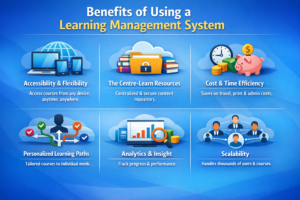
Using an LMS can greatly benefit both institutions and a corporate setting. Here are some of the learning management system attributes:
-
Accessibility and Flexibility
Students can gain access to the courses using any internet-enabled device, helping to create flexible learning environments. Such an aspect plays a critical role in serving international students.
-
The Centre-Learn Resources
Instead of having to handle files and content from different platforms, an LMS provides a central, secure repository that contains all learning content.
-
Cost & Time Efficiency
Digital classes mean that institutions save money associated with travel and print materials as well as infrastructure costs. Administrative time is reduced as a result of automation.
-
Personalized Learning Paths
There are many LMS systems that are able to accommodate the personalization of the learning process based on individual needs, preferences, and performance patterns.
-
Analytics and Insight
The reporting facilities offered by the LMS enable the detection of areas where learners need improvement, apart from helping understand the success achieved through training initiatives.
-
Scalability
Even in small schools or giant corporations, an LMS system easily handles thousands of people and courses.
How Institutions Use Learning Management Systems
Learning management systems fall into the category of highly versatile platforms and are used in different fields such as
-
Educational Institutions
The LMS system is applied by schools, colleges, and universities for online learning courses, handling registrations of students, conducting assessment tests, and communicating between lecturers and students.
In the context of remote or hybrid education, the application of the LMS system is very important.
-
Corporate Trainings
Organizations apply the LMS for the purpose of training new staff, as well as for compliance training and staff development.
By this, knowledge distribution is standardized and measurable for different departments.
-
Government and Nonprofits
Government bodies utilize LMS for training, compliance education, and public outreach campaigns, whereas nonprofits rely on it to train internal and voluntary members globally, including cost-effective open-source solutions.
-
Professional Development & Certifications
Professional associations utilize the LMS platform for providing continuing education units (CEUs), specific certifications, and training courses based on skills for members and partners.
Integrating LMS With Institutional Goals
To effectively leverage the potential of an LMS, it is important that the strategies of the institutions be aligned with what is possible through the use of technology.
Institutions of learning, for instance, would be in a position to determine which learners are struggling and develop strategies to work with this information.
Likewise, organizations would be in a position to incorporate the information from the LMS with the human resources of the organization to create specialized career training paths.
Collaborating with innovative technology companies such as cadence infotech can assist in designing and implementing an effective Learning Management System solution.
Future Trends in Learning Management Systems
The future will see the application of technology like artificial intelligence (AI), adaptive learning algorithms, and immersive technology being leveraged to turn the LMS platform into even more dynamic learning environments.
The inclusion of intelligent analytics will ensure that the technology of the future LMS redefines the way in which learning and training are conducted among the target audiences.
To wrap up
An LMS is a powerful and dynamic solution to manage and automate the modern learning process.
From enhancing conventional classroom education to being able to distribute courses to a wider audience online, an LMS makes learning more effective, accessible, and impactful.
As the landscape of digital education in India continues to change, the institutions with effective online learning solutions backed by experienced technology partners like Cadence Infotech are promising to lead from the front and solve future-ready learning experiences for learners across the globe.